Among all the attachments available for mechanised vegetation management, the saw blade pruner stands out as the specialist of clean cutting. Where flail mowers shred and mulchers grind, this machine slices through branches the way a careful arborist would, only much faster and on a far larger scale. Here is a closer look at how a saw blade pruner works, what it is made of and why it has become a reference tool for hedgerow, roadside and forestry maintenance.
Anatomy of a Saw Blade Pruner
A saw blade pruner is built around three main elements that work together.
The Cutting Bar
The heart of the machine is a rigid bar carrying several circular saw blades, typically between two and five depending on the working width. The blades overlap slightly so that no branch escapes the cut, and they spin at high speed to slice through wood in a single pass. Blade diameter varies by model: smaller blades for fine finishing work, larger ones for thick, mature branches.
The Hydraulic Drive
Each blade, or the bar as a whole, is powered hydraulically by the carrier vehicle. The hydraulic system delivers constant torque, which means the blades keep cutting cleanly even when they meet dense or hard wood. Flow rate and pressure requirements are key specifications to check against your tractor or excavator before mounting.
The Boom and Articulation
The cutting bar is fixed to an articulated arm that controls reach, height and angle. Depending on the configuration, the operator can cut vertically along the face of a hedge, horizontally across its top, or at an incline to shape a tree line. The best machines allow continuous adjustment from the cab, so the cutting position adapts to the terrain without stopping work.
What Makes the Cut Different
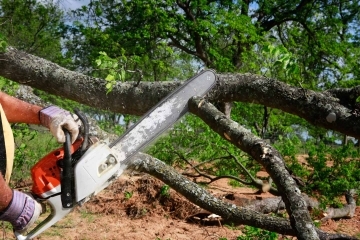
The defining feature of a saw blade pruner is the quality of its cut. A spinning saw blade severs the branch in one clean stroke, leaving a smooth surface comparable to a chainsaw cut.
This has three concrete benefits for the vegetation:
- Faster healing. A smooth cut surface closes quickly, while torn or crushed wood stays open for months.
- Lower disease risk. Open wounds are entry points for fungi and bacteria. Clean cuts dramatically reduce infection in hedges and trees.
- Better regrowth. Plants respond to a precise cut with dense, balanced shoots, which keeps hedgerows thick and windbreaks effective.
For landowners and authorities who must maintain the same vegetation for decades, these agronomic advantages often outweigh the raw speed of shredding tools.
Where a Saw Blade Pruner Earns Its Keep
The versatility of the saw blade pruner explains its adoption across very different sectors:
- Agricultural hedgerows: annual or multi-year maintenance of field boundaries, including the recovery of neglected hedges with thick stems.
- Roadside management: cutting back branches that reduce visibility or encroach on the carriageway, with a finish that satisfies both safety rules and residents.
- Forestry: pruning along forest edges, tracks and firebreaks, where branch diameters quickly exceed what lighter tools can handle.
- Railways and utilities: clearing vegetation along tracks and power lines, where reliability and cutting capacity are critical.
- Orchards and plantations: some configurations are adapted to topping and hedging fruit trees or maintaining plantation crops.
Keeping a Saw Blade Pruner in Top Condition
Like any cutting tool, a saw blade pruner performs only as well as its maintenance allows. Professionals should plan for:
- Regular blade inspection and sharpening. Sharp teeth are what make the clean cut possible; dull blades tear instead of slicing.
- Hydraulic checks. Hoses, couplings and motors live a hard life on the boom and deserve routine attention.
- Greasing and structural checks. Pivots and articulations take constant stress, especially on uneven ground.
- Genuine spare parts. Blades, bearings and guards should be replaced with parts matched to the machine to preserve balance and safety.
A well-maintained machine will deliver consistent results for many seasons, making it one of the most durable investments in a vegetation management fleet.
The Bottom Line
The saw blade pruner combines the precision of hand pruning with the productivity of mechanisation. For any professional who cares about the long-term health of hedges, trees and linear vegetation, and not just about clearing them, it represents the most convincing balance between speed, safety and respect for the plant.